Sunday, July 24, 2016

MSFS Day 1: L'arrivo (The Arrival)

Notes from the Field School: July 23rd, 2016

Students waiting to board
 the train to Milazzo.
This marks the official beginning of the first MSFS summer! The students all arrived safely in Sicily on Friday. Despite cancelled flights, lost luggage, ticketing complications, mechanical issues, and jet lag, everyone has survived their travels to the island and will be going home with stories that begin with the phrase, "Once we finally got to Palermo, everything was wonderful!".

We spent the night in a hostel near the central train station in Palermo. Saturday morning, we ate breakfast before walking to the station. Our train left around 9:00am to take us to Milazzo. For many of our students, this was their first experience taking the train...and yet they demonstrated extraordinary skill in loading luggage into the overhead racks and in retrieving all of the luggage in record time upon our arrival at our final destination. The train arrived in Milazzo around noon after 21 stops at small towns along the way. The students were able to see the mountains, the ocean, and the local architecture of the cities as the train sped away from Palermo.
In Milazzo, we were greeted by Dr. Dario Piombino-Mascali and a shuttle to take us to Santa Lucia del Mela. Following 20 minutes of beautiful scenery and winding streets, we arrived at our home for the next two weeks. The former convent where we are staying sits atop a hill and overlooks the city, providing a spectacular view both during the day and at night as the lights paint the Sicilian sky with hues of orange and white.

A view of Santa Lucia from the convent.
The first of many delicious lunches.


We were shown to our rooms and given a quick tour of the convent before lunch was served. We ate wonderful pasta with eggplant and a local cheese in addition to "chips" (french fries). We were also given delicious cheese-stuffed meatballs and fresh fruit with our meal. We had a few hours of downtime after lunch to settle in and explore for a bit prior to our evening event.

Poster announcing the reception for the
MSFS to the Santa Lucia community.


At 6:30pm, the class walked to the church to attend a reception with the mayor of Santa Lucia, Antonino Campo, officials of cultural heritage for Santa Lucia (Rosario Torre) and Sicily in general (Carlo Vermiglio), and member of the Santa Lucia general public. The above-named individuals sat at a panel with Dario and Karl and local journalist, Katia Trifiro. The panel discussed the cultural and scientific importance of the MSFS to Santa Lucia, to Sicily, to Italy, and beyond.


Reception panel discussion of the first MSFS in Santa Lucia.
Afterward, we went to view the crypt beneath the convent where we are staying and to meet the mummies that we will be working with during the MSFS. This was followed by a delicious dinner of arancini (a Sicilian dish with vegetables, meat, and cheese stuffed inside of a ball of rice and lightly fried) and pizza. The pizza were baked on focaccia or on puff pastry dough and included toppings of local cheeses, meats, and vegetables. Dessert was comprised of tarts, tiramisu cups, a chocolate and hazelnut gelato cake, biscotti, and candied almonds. The food, much like the community that came to welcome us this evening, was wonderful and we were thankful to be so well-cared-for upon our arrival to the city.

We were also invited to attend an outdoor opera concert. The performers sang beautifully. They sang from many of the classics, such as Carmen and the Turandot. This unplanned activity gave us all a chance to see an important part of Italian culture on a local level. The experience of watching an opera, perhaps even for the first time, while in Sicily is one that I am sure our students will remember for many years.

Opera singers entertaining an audience in Santa Lucia.
Strawberry-lemon
granita in Santa Lucia.


The day concluded with post-opera granitas at the city plaza. Students enjoyed the refreshing lemon and strawberry desserts before making the hike back up to the convent. The day was full of both exhaustion and excitement. The food is amazing. The people are wonderful. The culture is unique. The community is welcoming. We are all looking forward to spending the next few weeks in this beautiful place learning exciting new things about mummy studies and the relevance of such endeavors. Grazie, Santa Lucia!

Tomorrow will be filled by more excitement and less traveling. We are all ready to see what is yet to come during this inaugural MSFS here in Sicily. Stay tuned for tomorrow's notes from the field!


Written by Dr. Johnica J. Morrow (University of Nebraska-Lincoln)

Wednesday, July 13, 2016

Visiting Researcher Spotlight: Moi, Mari!

Mari Toppinen is a Ph.D. student in the Faculty of Medicine at the University of Helsinki in Finland. She is studying virology and her dissertation work focuses on the recovery of viral DNA from human remains. Mari holds a Master of Science from the Department of Biological and Environmental Sciences at the University of Helsinki. During her M.S., she majored in virology and graduated in 2013. She also did her minor studies in management at Aalto University, which is in Helsinki, Finland. Mari's favorite movie is the Godfather and she hopes to visit Corleone village while in Sicily...which is her ulterior motivation for coming to the island this summer. :p

Mari will be joining us in Sicily for part of the Mummy Studies Field School as a visiting researcher to gain some valuable experience that will help her with her dissertation work. We caught up with Mari to ask her about her involvement with our program this summer.

Hey, Mari! What made you interested in coming to Sicily to study mummies with us?
Our collaborator, Dr. Dario Piombino-Mascali, told us about the course and I got interested about the possibility to learn about mummies!

Would you describe your dissertation project for us?
We are studying virus DNA persistence in tissues of modern humans and ancient mummies. Several human viruses establish, after primary infection, lifelong persistence of their genomes in our tissues. Tracing the footprints of viruses in human remains reveals clues on their distribution and adaptation and may have major implications for our ability to control or eradicate infectious diseases.

How does Sicily fit into your dissertation project?
It is very important to learn about mummification processes and preservation of tissues. which probably influence virus DNA preservation.

What are you most looking forward to about the Mummy Studies Field School?
To see the Palermo Catacombs and the mummies there.

What are you most worried/anxious about?
I have only taken basic courses in anatomy and that was during my first year at university (2007) and I have forgotten most! In particular, my English vocabulary of different body parts is limited. However, I have been trying to learn those a little.

What are your plans following graduation?
I am now half way into my studies. I plan to graduate at 2018. I would like to continue with research, either in academia or in a company.

Who is your favorite mummy and why?
My favorite mummy is in the British museum. He is from 3400 BC, naturally mummified, and found from a sand grave in the Egyptian desert. He looks like he is sleeping with his hands under his head and knees bend. When in London, I need to visit him.

Monday, July 11, 2016

Mummy Monday: Little Rosalia Lombardo

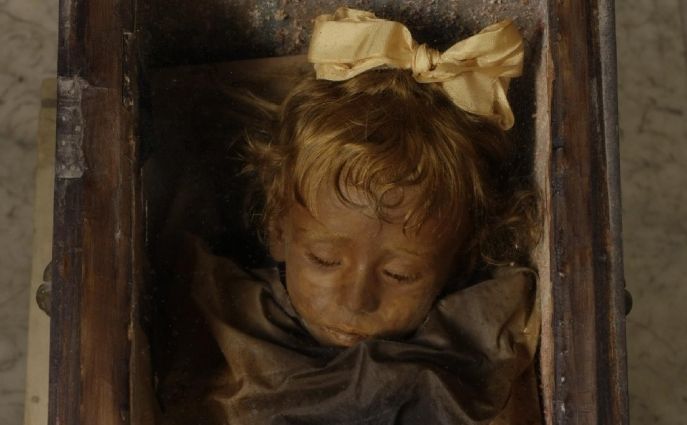
Today marks our final Mummy Monday posting prior to our departure for the MSFS! We've featured a wide range of mummies that our students will be meeting over the next few weeks in previous posts. Today, we will feature a very young and unique mummy. This mummy is Rosalia Lombardo and she is world famous for her beauty and excellent preservation. Rosalia was born in 1918 and died just two years later of pneumonia. Her father, Official Mario Lombardo, was distraught with grief and asked noted embalmer, Alfredo Salafia, to preserve her for the family. Salafia did such an incredible job with the embalming, that modern X-ray analysis has shown the girl's organs to be remarkably intact. She was one of the last corpses to be admitted into the Capuchin Catacombs of Palermo, where her body is kept in a glass coffin that has been hermetically sealed within a glass enclosure filled with nitrogen gas to prevent decay. This is one of the most well-preserved mummies within the catacombs.
Rosalia Lombardo rests in her coffin now safely enclosed within a nitrogen chamber.
Mummies Profile: Rosalia Lombardo


The face of Rosalia Lombardo
Lived: From 1918 to 1920

Sex: Female

Occupation in Life: None

Status: Child Mummy

Age at Death: 2

Cause of Death: Pneumonia

Place of Interment: Capuchin Catacombs of Palermo

Societal Importance in Death: Her excellent preservation has provided researchers with insights into embalming techniques of the early 1900s.

When Students Will Meet This Mummy: During the second week of the field school.

Dr. Dario Piombino-Mascali examines Rosalia Lombardo.

Wednesday, July 6, 2016

Visiting Researcher Spotlight: Oi, Elisa!

Elisa Pucu is a doctoral student at the Universidade Federal Fluminense (Fluminense Federal University) in Niterói, Brazil. She is currently studying Applied Microbiology and Parasitology for her Ph.D. Elisa earned her Bachelor’s and Licentiate degree from the Santa Úrsula University in Biological Sciences in 2009. She completed her Master’s degree in Parasitology from the University of Lincoln-Nebraska  in 2012. Elisa has been broadly trained in parasitology, archaeoparasitology, molecular biology, and mammalogy and has participated in interdisciplinary projects with collaborations from researchers at a number of different institutions. She started teaching undergraduates in 2010, and has taught biology and parasitology courses. Her experience with mummy research is focused on molecular biology of infectious diseases, parasite evidence, and arthropod fragments. For her dissertation, she has been working on the identification of infectious diseases in mummified remains from Sítio Justino in Sergipe, Brazil, and from the São Jorge Church, in Rio de Janeiro, Brazil.

Elisa will be joining us in Sicily for part of the Mummy Studies Field School as a visiting researcher to gain some valuable experience that will help her with her dissertation work. We caught up with Elisa to ask her about her involvement with our program this summer.

Hey, Elisa! What made you interested in coming to Sicily to study mummies with us?
I was applying for my doctorate when Dr. Karl Reinhard was in Rio de Janeiro. When we were discussing my project, he told me about this course and how it would be interesting for me. I was immediately captivated: first because of the topic of the course and how I could fit this in my dissertation, and second by the opportunity to learn and conduct research in Sicily. It is not everyday that we have a mummy course, especially in Italy!

Would you describe your dissertation project for us?
Sure! My dissertation is focused on ectoparasites and vectors and their infectious diseases in archaeological remains. I am currently working on molecular analysis of skeletons and human tissues in order to detect these diseases, such as the bubonic plague. I will also look for ectoparasites in hairs, coprolites, and clothes. From there, I will identify the ectoparasites morphologically and then analyze them molecularly to look for infectious diseases.

How does Sicily fit into your dissertation project?
It will be a course that will provide me a 'hands on' experience with mummies. Also, I will be able to analyze some ectoparasites and identify them morphologically, adding this information to my dissertation work. And, of course, this whole experience with different researchers in a different environment will enrich my dissertation in so many ways.

What are you most looking forward to about the Mummy Studies Field School?
I am looking forward to the catacombs and the fieldwork! I can't wait to see all those mummies that are so well preserved! 

What are you most worried/anxious about?
I am always anxious about the flights. 

What are your plans following graduation?
Well, I am still in my first year as a doctoral student...however, I am planning to teach parasitology at a university when I finish my Ph.D.

Who is your favorite mummy and why?

There are so many mummies that are so cool...but, one of my favorites is the dog mummy from Egypt. This mummy was analyzed and they found a bunch of ticks and other ectoparasites attached to its fur!

Tuesday, July 5, 2016

Mummy Monday: An Unknown Mummy Tells About Mummification

Welcome back to Mummy Monday! Last week, we discussed Saint Rosalia, the patron saint of Palermo. Today, we look at a mummy from the Capuchin Catacombs in Palermo that we know very little about. This mummy has been tentatively dated to the mid- to late 19th century. We do know know his identity in life, but analysis of his mummified corpse has given researchers insights into the way that people mummified their dead during this time period.

The unknown adult male mummy studied by
researchers during the Sicily Mummy Project.
As a part of the Sicily Mummy Project, researchers investigated this mummy using a mobile digital radiography system that they took with them inside of the catacombs. Their analyses revealed relatively homogeneous, radio-dense material in various veins and arteries as well as hyper-dense states in the liver and kidneys. They also found foreign bodies in the orbits as well as in the nasal and oral cavities. This told the researchers that the mummy had been created by skilled embalmers using an arterial injection of embalming fluid.


AP radiograph of the chest/abdomen showing arterial filling.
This mummy is one of many mummies on the island of Sicily that have unknown identities. Projects like the Sicily Mummy Project utilize modern technology to tell the stories of these anonymous individuals and the culture in which they lived. Mortuary practices are windows into our cultural past and being able to reconstruct these practices using scientific analyses of the mummies themselves give us a view of the past in ways that are not provided by historic texts or other artifacts.


Lateral radiograph of skull showing radio-dense foreign bodies.

Wednesday, June 29, 2016

Student Spotlight: Introducing Jordan!

Jordan Walther is a Forensic Science major at the University of Nebraska-Lincoln. He enjoys hunting and fishing like any other Nebraskan from Stockville. He's interested in crime scene investigation and can't wait for his learning adventure in Sicily! Jordan is also a student with a whole community supporting his education abroad. His hometown organized a fundraiser to help him get to the MSFS this summer. We tracked Jordan down to ask him about taking part in the 2016 UNL Mummy Studies Field School.

Hey, Jordan! How did you hear about our program?
My Junior year in Taphonomy class when Dr. Reinhard first came up with the plan to have this program two years later, and I knew right then I was going to be participating. 

What made you interested in our program?
Not only Sicily, but I have always been fascinated with mummies ever since I learned about them. 

What are you most looking forward to about our program?
I’m looking forward to the community, culture(food), and just learning the history in person. 

What are you most worried/anxious about your upcoming adventure in Sicily?
The different language may be a challenge that will possibly become a big charades game. 

What are your goals after you finish your undergraduate degree?
I am shooting to get on the federal level as a crime scene investigator or many of the other opportunities the feds provide. 

Is this your first time out of the country?
This will be the second time out of the country as I went on a Caribbean cruise with my grandma when I was in 6th grade. 

Do you know any Italian words or phrases yet?
Parli inglese?! (Do you speak English?!?)

Who is your favorite mummy?
I have gone into deep study into King Tutankamun and would say he is my favorite.

Jordan also had something else he wanted to say:
I would like to thank my community for making this possible financially. I could not have done it without everyone’s kindness and generosity. 

Monday, June 27, 2016

Mummy Monday: Saint Rosalia

Welcome back to Mummy Monday! Last week, we discussed the mummies of the Capuchin Catacombs of Palermo. Today, we will take a look at the patron saint of Palermo, Saint Rosalia. Also known by the names "La Santuzza" or "The Little Saint", this woman was born into a noble family that claimed to have been descendants of Charlemagne himself. She was devoutly religious and lived as a hermit in a cave on Mount Pellegrino. She is said to have been led to the cave by two angels. She died in this cave in 1166, leaving behind her bones and an inscription on the cave wall that read, "Rosalia, daughter of Sinibald, Lord of Roses, and Quisquina, have taken the resolution to live in this cave for the love of my Lord, Jesus Christ." In 1624, she is said to have appeared to a hunter during a time when a plague was upon Palermo. She ordered the hunter to collect her remains from her cave and to take them to Palermo to be carried in procession throughout the city. The hunter did as he was told and carried her remains around the city three times. Afterward, the plague ended and Saint Rosalia was venerated as the patron saint of Palermo. A sanctuary was built in the cave where she had lived.


A painting of Saint Rosalia hangs above her altar in Palermo.
Mummies Profile: Saint Rosalia
The silver altar of St. Rosalia.


Lived: From 1130 to 1166.

Sex: Female

Occupation in Life: Hermit

Status: Patron Saint of Palermo, Italy

Age at Death: 36

Cause of Death: Unknown

Societal Importance in Death: An annual celebration and feast is held for her in July. This is one of the major social and religious events held in Palermo. A related event is held annually in September and involves a tradition of walking barefoot from Palermo up to Mount Pellegrino.

When Students Will Meet This Mummy: During the second week of the field school.